

Key Takeaways
Introduction
Many businesses now use containers to run applications in a more scalable way. As container use grows, teams need a reliable way to manage those containers across different environments. Kubernetes is often used for this purpose. Kubernetes helps organizations manage containerized workloads and services.
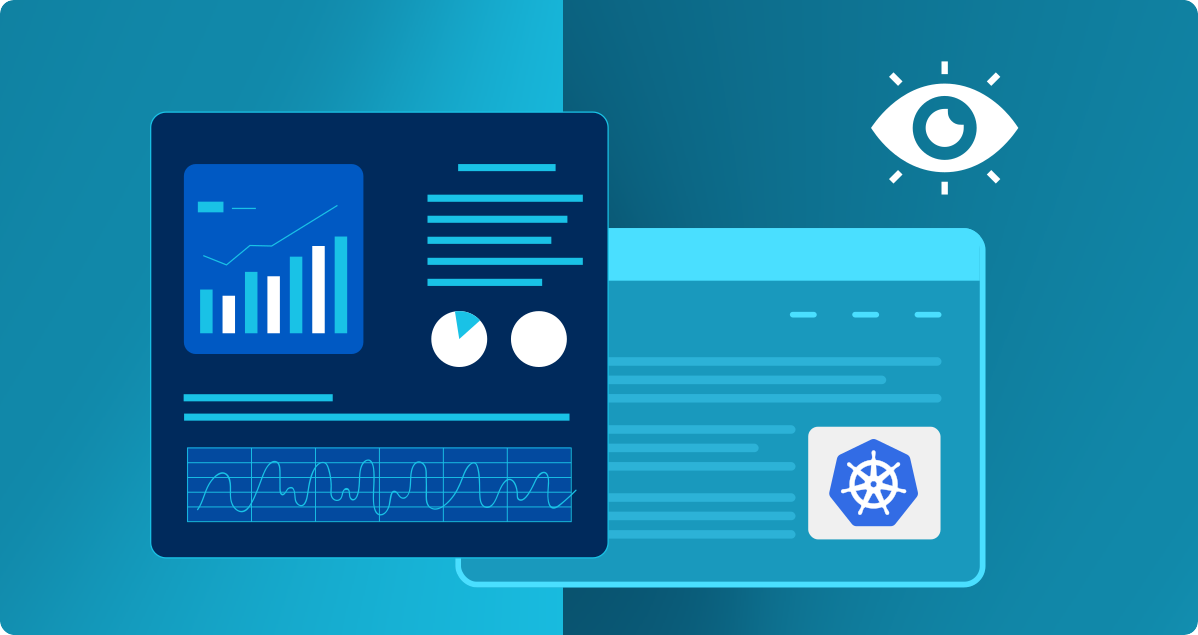
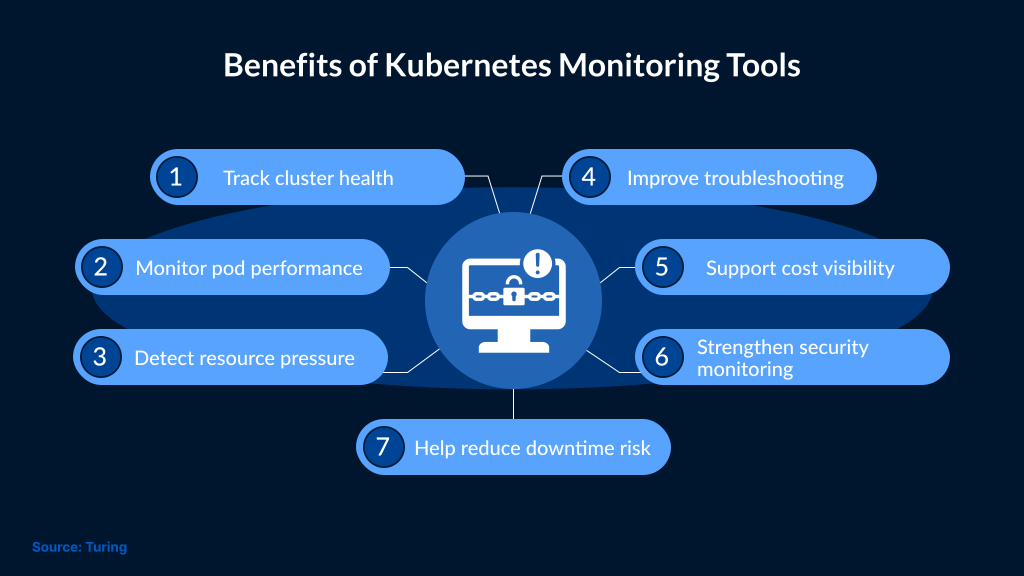
But these environments are not always easy to monitor. Clusters can be distributed, and workloads can change quickly. Pods, nodes, and services also generate significant activity that teams need to track. Kubernetes monitoring tools help teams see how their clusters are running. They show performance, health, resource usage, and security-related activity across the environment.
Kubernetes monitoring tools enable companies to monitor how their resources are used, identify potential bottlenecks, and detect security risks across their clusters. As the use of microservices grows, maintaining optimal performance is essential to ensure applications run smoothly. These tools give teams real-time data and alerts that help them reduce downtime risk and take proactive steps. A CNCF survey found that 96% of businesses are either using or looking into Kubernetes. This makes it more important than ever to have strong monitoring tools.
How Kubernetes Monitoring Tools Improve Security
Kubernetes monitoring tools enhance the security of Kubernetes clusters. They also help improve the performance of these clusters by detecting anomalies like unauthorized access or unusual traffic patterns that could indicate a security incident. Companies can combine these tools with their existing security solutions to meet compliance requirements and reduce the risk of cyber threats.
Modern monitoring tools can also be connected with cloud-native security tools. This connection helps teams monitor both performance and security from a single interface. With the rise of DevSecOps, Kubernetes monitoring tools now play an important role in keeping containerized systems secure while continuing to run at their best.


Five Reasons Why Monitoring Kubernetes Is Important
It is important to set up a strong monitoring plan for Kubernetes for the reasons below:
Troubleshooting and reliability: Kubernetes applications, especially those built on cloud-native or microservices architectures, can be very complex. When problems happen, it can be hard to figure out what caused them. Proper Kubernetes monitoring lets you see where problems occur or are likely to occur and provides information you can use to prevent or fix them before they affect your system.
Kubernetes performance tuning: Monitoring your Kubernetes cluster can teach you a lot about its working. Additionally, you can learn how to make the best use of your resources and achieve optimal performance without putting extra pressure on existing resources or reducing application efficiency.
Cost management: Companies that use public cloud resources to run Kubernetes need to monitor the number of active nodes or compute instances, as this directly affects their costs. Monitoring ensures you know whether resources are being overused or underused, even outside the public cloud. This helps reduce waste or inefficiency.
Cost allocation and chargebacks: Kubernetes monitoring provides the information you need to see how costs and resources are divided among teams. By looking at usage data, you can see which teams or projects are using which resources. This makes chargebacks, showbacks, and cost analysis for your Kubernetes environment easier.
Security: Because threats change quickly, you need visibility into your Kubernetes environment. Monitoring helps detect unauthorized pods, containers, or jobs. It also looks for unusual traffic coming in and going out. To identify security risks and keep your container environment secure, you need to include Kubernetes monitoring tools in your security strategy.
Popular Open-Source Kubernetes Monitoring Tools
These open-source tools are among the most commonly used for monitoring cloud and Kubernetes environments. Let's look more closely at what they can do.
1. Headlamp
Headlamp is a web-based Kubernetes user interface used by teams to view and manage Kubernetes clusters. The user interface makes it easier to see important data from containers and pods running in your clusters. Users can also view and manage key parts of a Kubernetes cluster.
Key features include:
- Visualization of applications running in pods.
- Monitoring of resource usage in pods.
- Detection and diagnosis of pod-related errors.
- Ability to view and update Kubernetes resources.
2. The Prophet
Prometheus is one of the most widely used open-source tools for monitoring Kubernetes. It was first made by SoundCloud and later joined the Cloud Native Computing Foundation. Prometheus collects and stores metrics as time-series data and has become a standard tool for monitoring Kubernetes.
Prometheus is made up of:
- The Prometheus Server scrapes metrics from configured targets and stores them.
- Alertmanager sends alerts when certain conditions are met.
- Exporters expose metrics from systems and services.
Some important features of Prometheus are:
- A multidimensional data model for time-series data.
- PromQL, a query language for looking at data.
- A pull-based model for collecting metrics over HTTP.
3. Jaeger
Developed by Uber, Jaeger is an open-source distributed tracing tool now part of CNCF. It is widely used for monitoring and troubleshooting complex microservices architectures. Jaeger provides distributed tracing to optimize service performance, uncover latency issues, and trace the root causes of failures across Kubernetes environments.
4. ELK is an elastic stack
The Elastic Stack is a well-known open-source search, analytics, and log management platform that can ingest Kubernetes logs. It combines several tools:
- Elasticsearch stores and searches logs, including Kubernetes logs.
- Logstash collects and processes logs before sending them to Elasticsearch.
- Kibana helps teams visualize and analyze log data.
- Beats or Elastic Agent can collect logs and metrics from Kubernetes and Docker environments.
5. Grafana
Grafana is a popular open-source tool used for monitoring and analytics. It works well with Kubernetes and Prometheus. This tool generates detailed charts and graphs from time-series data that teams can use to assess the health of Kubernetes clusters. Another notable feature of Grafana is its ability to connect to multiple data sources like Prometheus, Elasticsearch, and InfluxDB. This makes it a useful hub for monitoring Kubernetes environments.
Here are some of the key features of Grafana:
- Flexible dashboards that display data from different sources.
- Integration with alerting tools to get real-time alerts.
- Plugin support for additional data sources and integrations.
- It is often used with Prometheus to show Kubernetes data in an easy-to-understand way.
6. The advisor
Container Advisor, or cAdvisor, is an open-source monitoring tool that collects data from containers and other containerized environments. The tool was designed by Google. It is usually combined with other monitoring tools like Prometheus to support Kubernetes monitoring. cAdvisor collects information about running containers on how they use resources such as CPU, memory, network bandwidth, and file systems.
Some of cAdvisor's most important features are:
- Automatic discovery of containers running on a machine.
- Real-time monitoring of container resource usage.
- Collecting performance metrics for container monitoring.
- Container-level insights for tracking cluster performance.
Conclusion
Kubernetes environments become harder to manage as they grow. When workloads increase, organizations add more resources to monitor them. More access points can also increase security risk. Such issues can be identified earlier through monitoring tools. SafeAeon helps organizations use that visibility to keep Kubernetes environments more stable and secure.
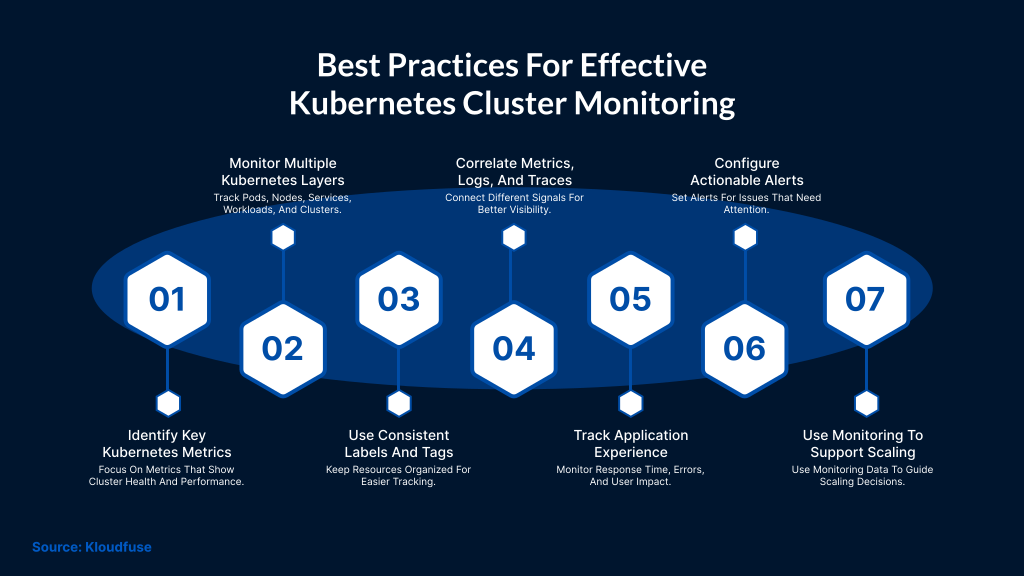
These tools support a wide range of functionalities like resource monitoring, scaling decisions, alerting, and security visibility. All these are important for maintaining availability and reducing downtime risk.
Kubernetes monitoring tools are also crucial as demand for cloud-native applications rises. With these tools, teams can easily identify performance issues and security risks before they escalate. As a result, applications continue to work smoothly despite the changes in environments. Businesses can get more value from Kubernetes while keeping their systems and data more secure by using the right monitoring tools.