


Key Takeaways
- 71% of companies track their cryptographic algorithms, but only half successfully apply those rules organization-wide. (Global News Wire)
- Global encryption software grew from $14.50 billion in 2023 to $16.70 billion in 2024, showing a 15.1% increase in the trend. (Scoop US)
Introduction
Data breaches are becoming more common because of the constant evolution of online threats. It is important to use strong encryption to protect sensitive data. NSA Suite B Encryption is one of the most commonly used standards that was defined by the National Security Agency (NSA) to provide a set of approved cryptographic algorithms.
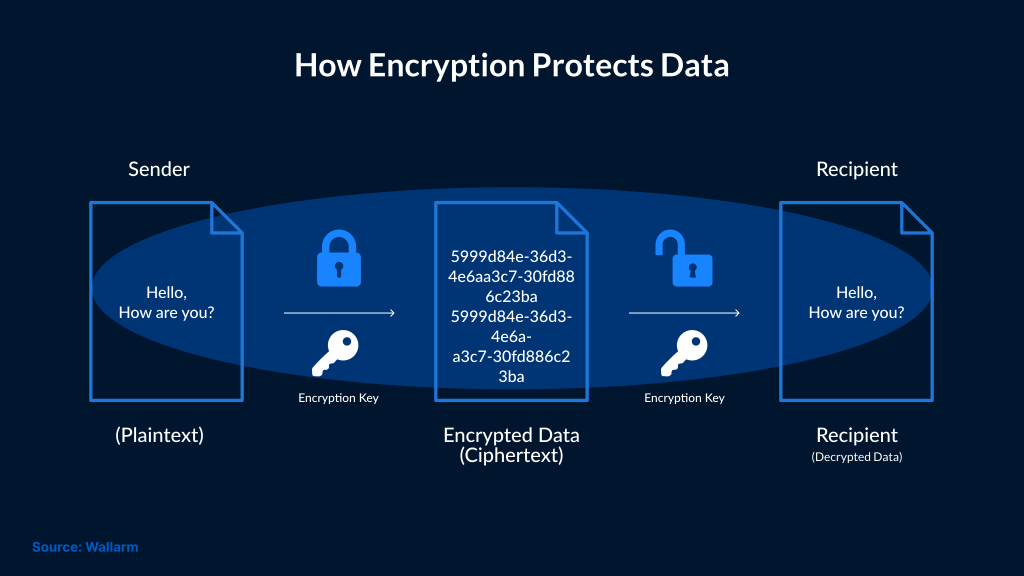
These algorithms are widely used to protect sensitive information across sectors, including government, military, and corporate. Organizations can use advanced methods, such as Suite B cryptography, to enhance data protection against unauthorized access.
NSA Suite B Encryption includes multiple cryptographic mechanisms like Elliptic Curve Cryptography (ECC), Advanced Encryption Standard (AES), and Secure Hash Algorithm (SHA). These components work together to support data confidentiality, integrity, and authentication. Suite B was designed to provide strong encryption that is aligned with known security requirements and to address imminent cyber threats.
The Role of NSA Suite B in Securing Sensitive Data
NSA Suite B encryption has been used beyond government environments and has influenced sectors such as healthcare, banking, and telecommunications, where protecting personal and financial information is critical. Suite B cryptography, for example, has supported the secure transmission of military communications and improved the security of financial transactions. The Commercial National Security Algorithm (CNSA) Suite has replaced Suite B for U.S. national security systems. Suite B remains relevant as cryptographic standards evolve and continues to influence modern encryption practices.
Things to Know About NSA Suite B Encryption
The U.S. government provides technical guidance on IT systems and security, including recommendations on data encryption. Through its Suite B standard, the U.S. National Security Agency (NSA) defined a set of cryptographic algorithms that can be used together.
Suite B outlines a framework that specifies a defined set of approved cryptographic algorithms. Some of these include:
- Advanced Encryption Standard (AES) for encryption
- Elliptic Curve Diffie-Hellman (ECDH) for key exchange
- Elliptic Curve Digital Signature method (ECDSA) for digital signatures
- SHA-256 or SHA-384 for hashing
The RFC 6460 standard also defines Suite B-compliant profiles that describe configurations required to align with Suite B. The following profiles are defined:
- Suite B-compliant profile for TLS 1.2: Configured to use only the set of cryptographic algorithms defined in Suite B
- Transitional profile for TLS 1.0 or TLS 1.1: Allows interoperability with systems that are not fully Suite B-compliant. It also supports additional cryptographic options
Suite B and FIPS 140-2 are not the same. Suite B defines approved cryptographic algorithms, while FIPS 140-2 specifies requirements for validating cryptographic modules. Systems that implement Suite B-aligned configurations may also need to meet FIPS 140-2 validation requirements.
IBM MQ can be configured to use TLS 1.2 settings aligned with Suite B on AIX, Linux, and Windows systems, but it does not support all transitional profiles.
Background Details
Because technology is evolving rapidly, a flexible approach is needed to help protect national security information. The National Security Agency (NSA) introduced Suite B Cryptography at the 2005 RSA Conference 2005. This aligned with the National Policy on the Use of the Advanced Encryption Standard (AES) to Protect National Security Systems and National Security Information (CNSSP-15). Suite B builds on AES by including additional cryptographic algorithms for hashing, digital signatures, and key exchange.
This set of cryptographic algorithms was intended to protect both classified and unclassified national security systems and data. NSA Suite B encryption could be used by U.S. government agencies because it includes algorithms approved by the National Institute of Standards and Technology (NIST). When the NSA introduced Suite B, the goal was to provide a standardized set of algorithms that could also be adopted by industry to meet U.S. Government (USG) requirements.
However, Suite B defines only the cryptographic algorithms. Other factors must be considered to determine whether a system using these algorithms is suitable for a given use case. Some of these factors include:
- How well the cryptographic algorithms are implemented in hardware, software, or firmware
- Operational requirements for key management
- The sensitivity and classification of the data being protected
- Interoperability requirements at national and international levels
These aspects are not covered by Suite B because it focuses only on cryptographic algorithms and represents one part of a broader information security system. The NSA also developed Suite A, another cryptographic suite. It includes classified algorithms that are not publicly available and are used to protect highly sensitive information within parts of the national security community.
Key Components of NSA Suite B Encryption
NSA Suite B comprises a set of cryptographic algorithms used to protect and access data. Some of these include:
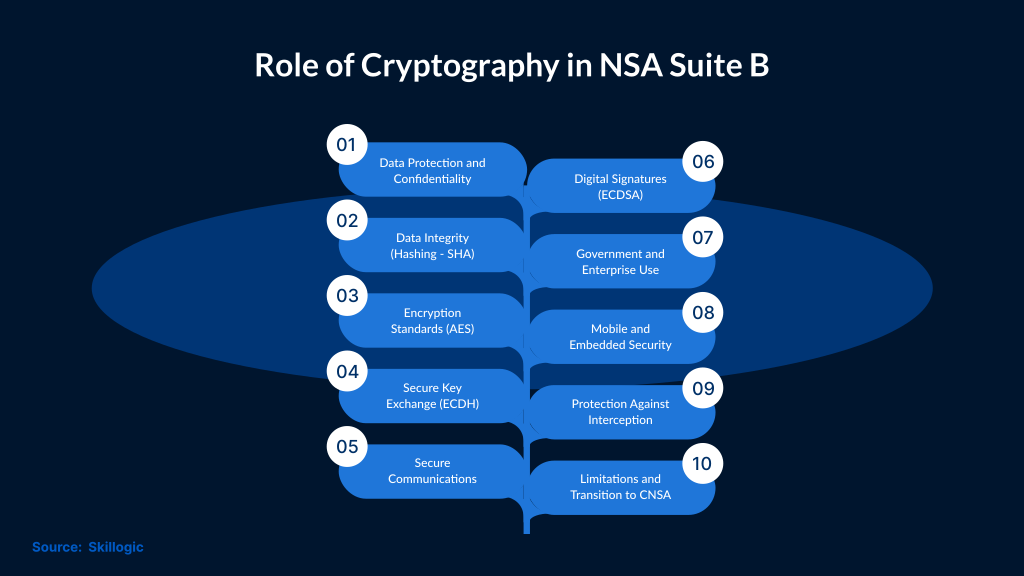
Elliptic Curve Cryptography (ECC): It provides strong security with smaller key sizes than other public-key algorithms, such as RSA. This improves performance, especially for mobile devices and embedded systems.
Advanced Encryption Standard (AES): AES is a symmetric-key encryption algorithm widely used for securing data. It is considered a strong and trusted standard across government and industry.
Secure Hash Algorithm 2 (SHA-2): SHA-2 is a family of cryptographic hash functions that convert input data into fixed-size hash values. These hashes are used for functions such as verifying data integrity and supporting digital signatures.
How NSA Suite B Helps Keep Private Information Safe
Strong Encryption: The NSA Suite B algorithms are designed to provide strong encryption, making it difficult for unauthorized parties to access or interpret protected data. This helps protect data from unauthorized access, theft, and tampering.
Smaller Key Sizes: Compared to other public-key methods, ECC, a key component of Suite B, provides strong security with smaller key sizes. This improves performance on mobile devices and embedded systems with limited computing power.
Flexible: NSA Suite B is a set of algorithms used to protect different types of data and applications. It can be applied in both government and commercial environments.
Interoperability: Many software and hardware platforms support algorithms included in Suite B. This allows compatibility across different systems, which organizations integrate these cryptographic standards into existing environments.
Government Endorsement: Suite B was defined by the U.S. government, which led to its adoption in national security systems. It is usually used in environments where government-approved cryptographic standards are mandatory.
How NSA Suite B is Used in the Real World
In practice, NSA Suite B has been used in areas such as:
Government Data: Suite B has been used to protect classified and sensitive data handled by government agencies.
Financial Services: Banks and financial institutions have used Suite B-aligned algorithms to help protect customer information, such as credit card and account data.
Healthcare Data: Healthcare organizations have used these cryptographic algorithms to protect patient records and sensitive medical data.
Mobile Devices: Suite B algorithms have been applied to help secure data on mobile devices against unauthorized access.
IoT Devices: Some Internet of Things (IoT) environments have used these algorithms to help protect sensitive data.
NSA Suite B has been an important part of cryptographic standards. However, it has been replaced by the Commercial National Security Algorithm (CNSA) Suite for U.S. national security systems. Its relevance today is mainly in understanding the evolution of modern cryptographic practices.
Conclusion
NSA Suite B Encryption has played an important role in protecting sensitive data across different environments by using established cryptographic algorithms. However, Suite B is no longer an active standard for U.S. national security systems and has been replaced by the Commercial National Security Algorithm (CNSA) Suite.
At SafeAeon, encryption strategies are aligned with current standards and evolving security requirements through continuous monitoring, implementation support, and security operations.